The Digital Infrastructure Boom: Why Data Literacy is Australia’s Most Valuable Professional Currency

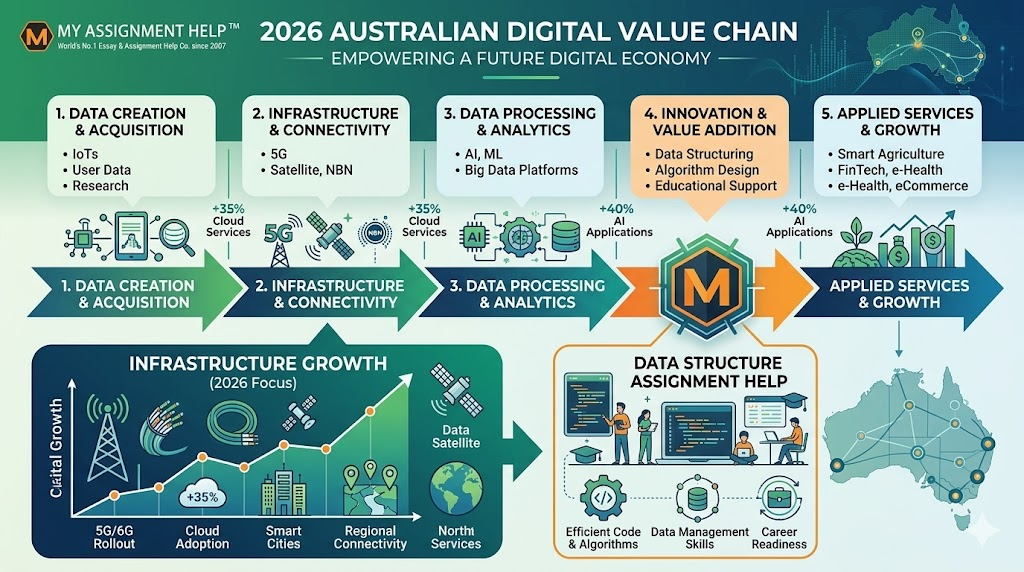
In the rapid economic evolution of 2026, the Australian landscape is no longer defined solely by its vast minerals or agricultural exports. Instead, the nation is now anchored by a formidable digital backbone. As the Commonwealth continues to invest heavily in the “Digital Economy Strategy,” a new hierarchy of professional assets has emerged. At the pinnacle of this hierarchy lies data literacy—a competency that has shifted from a niche technical requirement into the most liquid professional currency in the modern Australian workforce.
The Critical Skills Gap in the 6G Era
This “Digital Infrastructure Boom” represents a fundamental restructuring of how business is conducted. From the burgeoning fintech hubs in Sydney’s Barangaroo to the logistics powerhouses in Adelaide, real-time data analytics now govern every strategic move. However, this rapid shift has exposed a significant skills gap. As Australian universities tighten their grading rubrics to match 6G infrastructure demands and global industry standards, the role of supplemental academic support has transitioned from a luxury to a strategic necessity for students. To navigate this high-pressure climate, many are leveraging expert assignment help Australia to ensure their academic output aligns with the rigorous, real-world expectations of the 2026 job market.
The Architecture of Efficiency: Logic Over Information
The true driver of the digital boom is structural efficiency. Modern Australian enterprises require systems that can retrieve, process, and scale information with near-zero latency. The core principles of algorithmic efficiency and memory management have migrated from the computer lab directly into the corporate boardroom.
In the current Australian tech market, a candidate’s ability to optimize information retrieval is a direct indicator of their potential ROI to a firm. This is why subjects like advanced algorithmic logic are now mandatory in high-tier degrees. Students often find that mastering these concepts is the most significant hurdle of their curriculum, frequently relying on targeted Data Structure Assignment Help to grasp the nuances of non-linear data types and complex sorting algorithms that drive today’s cloud-based infrastructures.
Bridging the Gap: Academic Theory to Professional Value
The transition from a university student to a data-literate professional is fraught with challenges. The complexity of local higher education standards means students must move beyond rote learning to demonstrate Information Gain—the ability to provide insights that are uniquely valuable to a business. By utilizing expert pedagogical resources, students aren’t just passing exams; they are architecting their future “Net Worth” in a sovereign digital economy.
Key Takeaways
- Data as Capital: Technical literacy is the primary correlate with career longevity in the Australian market.
- Sovereign Infrastructure: The 2026 boom prioritizes “on-shore” data experts over outsourced talent.
- Foundational Logic: Mastery of Data Structures is the non-negotiable entry requirement for top-tier analytical roles.
- Strategic Support: Specialized academic resources are the bridge between university theory and 6G industry readiness.
See also: Decorator Advice .Com – Expert Home Decorating Advice at Decoratoradvice
Frequently Asked Questions: Australia’s Digital Economy & Academic Excellence
1. Why is data literacy being called the “new currency” in the Australian job market?
By 2026, the Australian economy has shifted toward a sovereign digital model. “Data literacy” is no longer just for coders; it is the ability to interpret complex systems to drive business ROI. Professionals who can navigate these infrastructures command a “literacy premium,” often earning significantly higher median salaries compared to those with only generalist skills.
2. How has the grading rubric changed for Australian university students in 2026?
To keep pace with the 6G infrastructure boom, Australian institutions have tightened their grading rubrics to emphasize “Information Gain” and practical application. Students are now expected to demonstrate how technical concepts, such as algorithmic efficiency, solve real-world industry problems, making academic precision more critical than ever.
3. Why is “Data Structure” considered the most difficult yet essential module?
Data structures form the logical “engine” of all modern digital infrastructure. In Australia’s competitive tech sector, mastering these—from non-linear data types to sorting algorithms—is the non-negotiable entry requirement for high-tier roles. Because of this complexity, many students utilize specialized Data Structure Assignment Help to bridge the gap between abstract theory and industry-standard execution.
4. How does supplemental academic support address the Australian “Skills Gap”?
As the gap between university curricula and 6G industry demands widens, supplemental support has become a strategic necessity. Expert assignment help Australia provides students with the pedagogical resources needed to meet rising industry expectations, ensuring they graduate with the technical literacy required by ASX 200 employers.
Author Bio
Dr. Alistair Vance Dr. Alistair Vance is a Senior Academic Content Strategist at MyAssignmentHelp. With a doctorate in Information Systems and 15 years in the Australian education sector, he specializes in aligning academic curricula with 6G industry demands. He is a leading advocate for the “Industry Observation” model of student development.